
Crosswind Careers
October 17, 2026

If you are searching for how to get a SPIN placement, there is one thing to know before anything else. SPIN, the Space Placements in INdustry scheme, was the UK's best-known route into a paid summer placement in space engineering and the wider space sector, and for 2026 the government replaced it with a similar programme called Skills for Space. The details of how you apply, who you apply to and what you get paid have all shifted, and a lot of the guides still ranking on Google describe a scheme that no longer runs in its old form. This guide covers how SPIN worked, what replaced it, what the current position is as of October 2026, and what you can do now to be ready for the next round or to get the same experience another way.
SPIN stands for Space Placements in INdustry. According to the Satellite Applications Catapult, which managed it, the scheme has run since 2013. The UK Space Agency funded it. The idea was simple. Space organisations in the UK, from large primes to start-ups and university research groups, could apply for a grant to take on a paid student intern over the summer. The grant covered the intern's pay, so a small company that could not otherwise afford a student for two months could take one on.
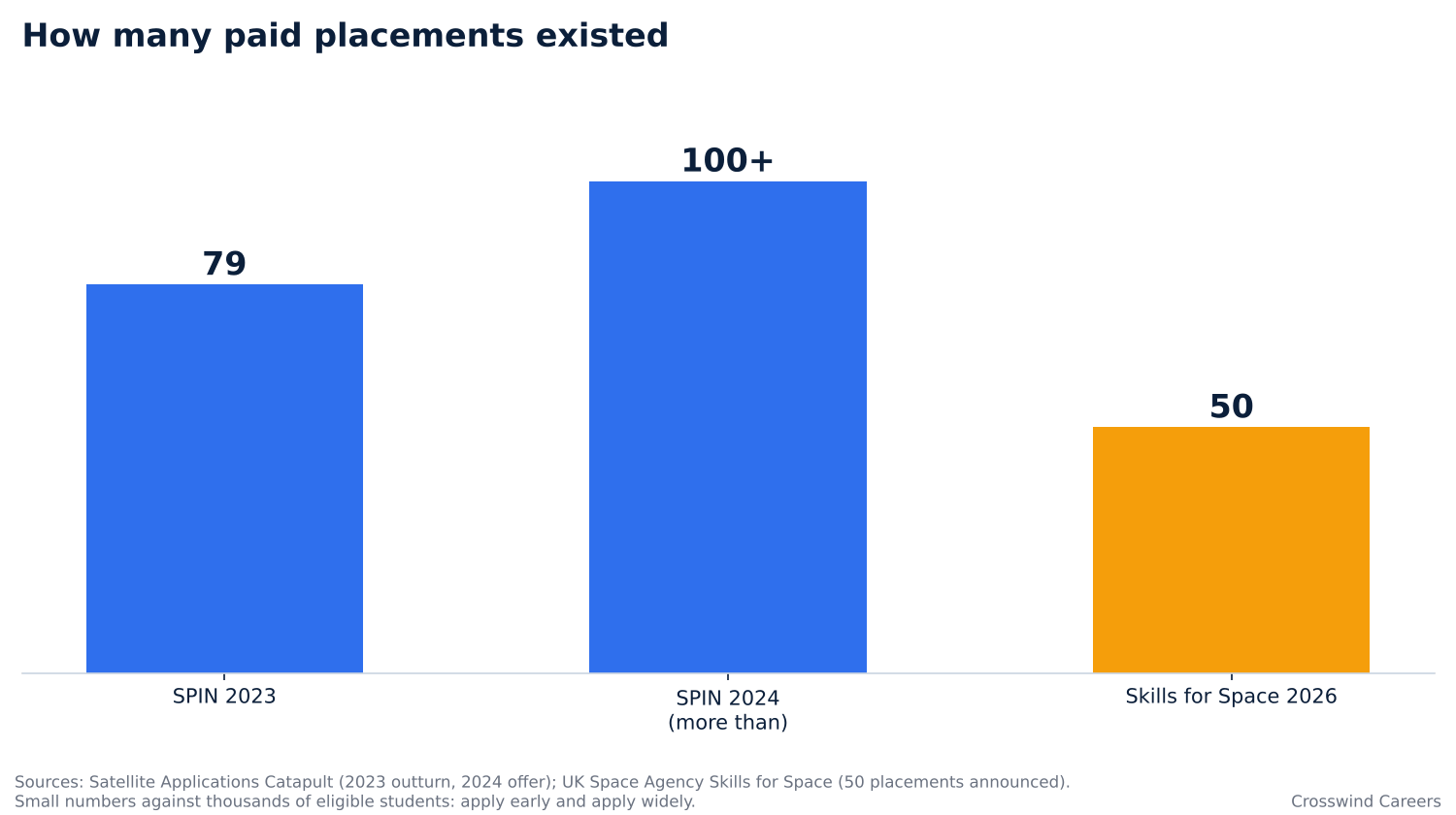
The numbers give a sense of scale. In 2023 SPIN provided 79 student placements across 56 organisations, and for 2024 the Catapult said it was offering more than 100 opportunities. It was a real programme, but it was never huge. A few dozen to a little over a hundred places across the whole country is small against the thousands of students who study engineering, physics, computing and related subjects every year.
Placements were not limited to space engineering in the narrow sense. Projects were open to students from any discipline, not only STEM, and the 2024 host booklet told employers not to ask for prior work experience, because the point of the scheme was to give students that experience in the first place. You could end up on a satellite data project, a mission operations team, a software task, a policy project or a business and marketing role at a space company.
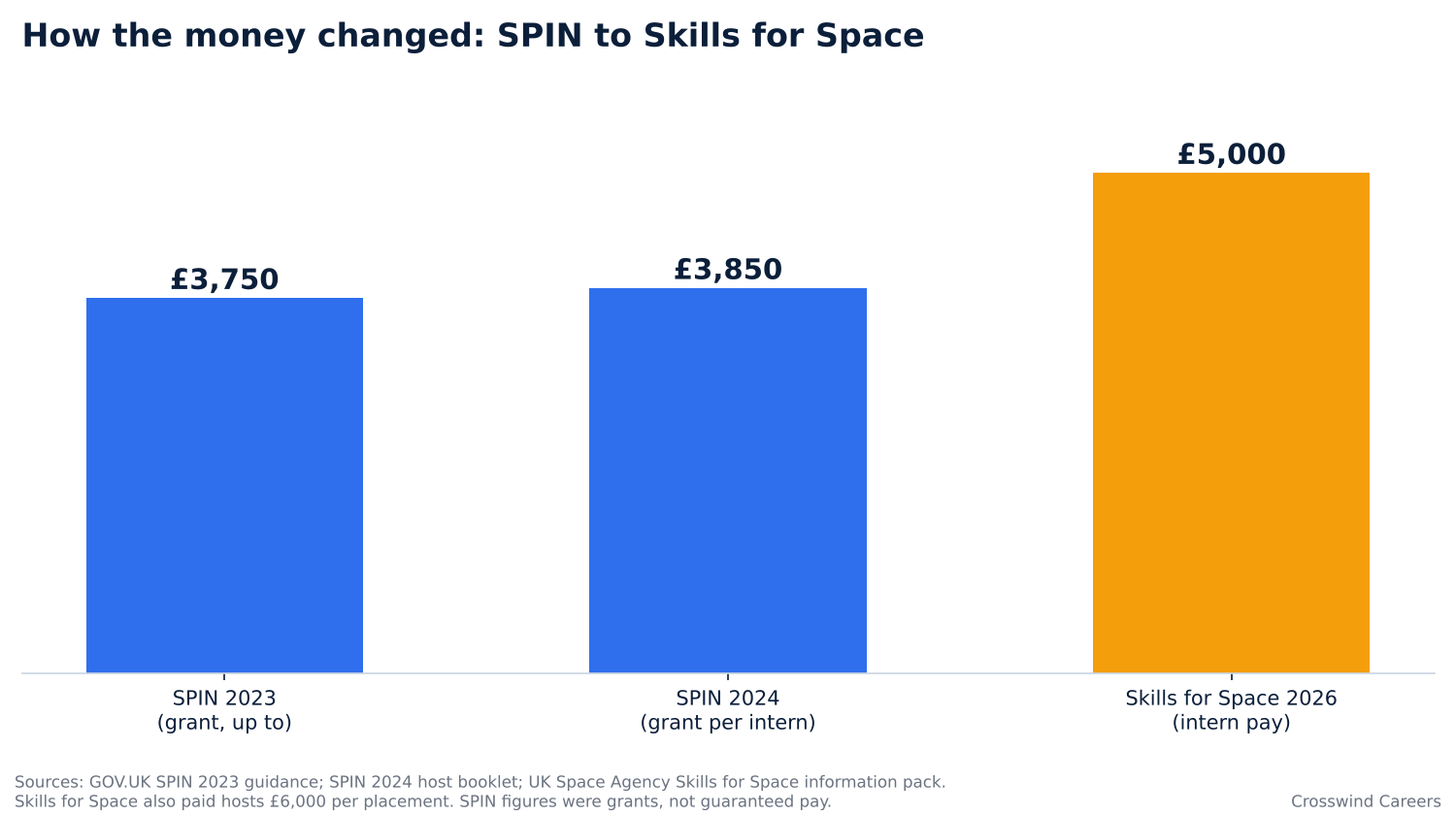
The 2023 guidance published on GOV.UK set grants of up to £3,750 per award, with interns paid at least the National Living Wage. By 2024 the grant was £3,850 per intern, plus £100 towards travel and attendance at the Showcase Event. A placement typically lasted eight weeks, though a host could fund extra time at its own expense, and the Catapult noted that some students found placements that ran as long as a year.
Every SPINtern attended an induction day, which in 2024 was held at the Satellite Applications Catapult in Harwell, and then presented their work at a Showcase Event at the end. The 2024 host booklet also asked students to produce an academic poster covering the host company, the project and what they learned, and to prepare a two-minute pitch. That poster mattered because it fed into the final report and the grant payment process. If you are ever lucky enough to get a placement like this, treat the poster as part of the job, not as homework.
For the years when the Catapult handled student recruitment, the process worked like this. Host organisations applied first, and a panel scored their project proposals. The funded projects were then advertised on the Catapult's SPIN pages for about four weeks, from early January to around mid-March in 2024. Each advert linked to an online platform called Applied, which ran the applications, the sift questions and the tracking. Applications were anonymous at the sift stage, which means the people reading your answers did not see your name or your university when they first scored you.
Interviews took place within about two weeks of the advertising period closing, and applicants were told the outcome within four weeks of the closing date. Hosts appointed their interns by the end of April, and start dates were agreed between you and the host, either before or after the induction day in late June.
The practical lesson from that structure is that the sift answers do the heavy lifting. If a recruiter is scoring anonymous answers against the skills in the listing, the way you describe a project, a piece of coursework or a hobby build is what gets you to interview, not where you study. The Catapult's own advice to students was to read each listing carefully and tailor your answers to the skills it asks for. That sounds obvious, and most applicants still do not do it.
The Catapult's participant evaluation, which it discussed in a February 2024 interview, makes the case for why people wanted these placements so much. The average feedback rating was 9.35 out of 10. Ninety-five per cent of participants said they were keen to work in the UK space industry, and every respondent said the programme improved their career opportunities. Around 40 per cent received a job offer immediately after finishing, and the Catapult said many interns get offers from their host companies and some former interns now hire SPINterns themselves.
Treat those figures with the usual care you would apply to any scheme's own survey, since the people running a programme are the ones reporting on it. Even so, the direction is clear and matches how hiring works in a small industry. Space is a sector where people know each other. An eight-week placement where a manager sees your work first-hand is worth more than a line on a CV.

For summer 2026 the UK Space Agency launched Skills for Space, a paid internships programme that its own documents present as an evolution of SPIN. It keeps the focus on developing future space talent, but changes who can apply and how the matching works.
Feature | SPIN (2023 and 2024) | Skills for Space (2026) |
|---|---|---|
Funded by | UK Space Agency | UK Space Agency |
Run by | Satellite Applications Catapult | UK Space Agency |
Placements | 79 in 2023; more than 100 offered for 2024 | 50 |
Length | About 8 weeks | 8 weeks |
Money | Grant of up to £3,750 (2023) and £3,850 per intern (2024) | £5,000 intern pay; £6,000 per placement to the host |
Who could apply | Students from any discipline | Second- and third-year undergraduates and second-year FE students |
How you applied | To individual projects, through the Applied platform | Pooled candidates, matched centrally to hosts |
Past SPIN interns | Eligible | Not eligible |
The headline details from the programme information are as follows. The programme was announced as 50 paid, eight-week placements running through July and August 2026. The total remuneration for an intern was £5,000, and the host funding was £6,000 per placement, made up of £5,000 for the intern's salary, aligned with the National Living Wage, and £1,000 towards the host's administrative costs. Travel and food for the induction day and the showcase were covered on top.
Eligibility was narrower in one way and wider in another. Interns had to be second- or third-year undergraduates, or second-year Further Education or tertiary students, and had to be continuing in full-time education from September 2026. Widening the scheme to include FE learners was one of the stated changes from SPIN. Applicants had to be aged 18 or over with the right to work in the UK, and they had to provide an academic transcript and a character reference from an academic advisor or supervisor. The information pack also says interns must be first-time participants and cannot have held a UK Space Agency sponsored internship before, which explicitly includes a SPIN placement. If you did SPIN once, you cannot do Skills for Space.
The big structural change is in matching. Under SPIN, you applied to individual projects. Under Skills for Space, hosts do not recruit directly. The UK Space Agency pooled candidates against each host's specification and ran a structured matching process that took account of both sides' preferences. Hosts blind-ranked shortlisted candidates, took part in interviews, and had the final say on who they signed. The programme documents are also explicit that no previous technical space experience was needed. The Agency said it was looking for motivated candidates with good communication, numeracy, IT and language skills.
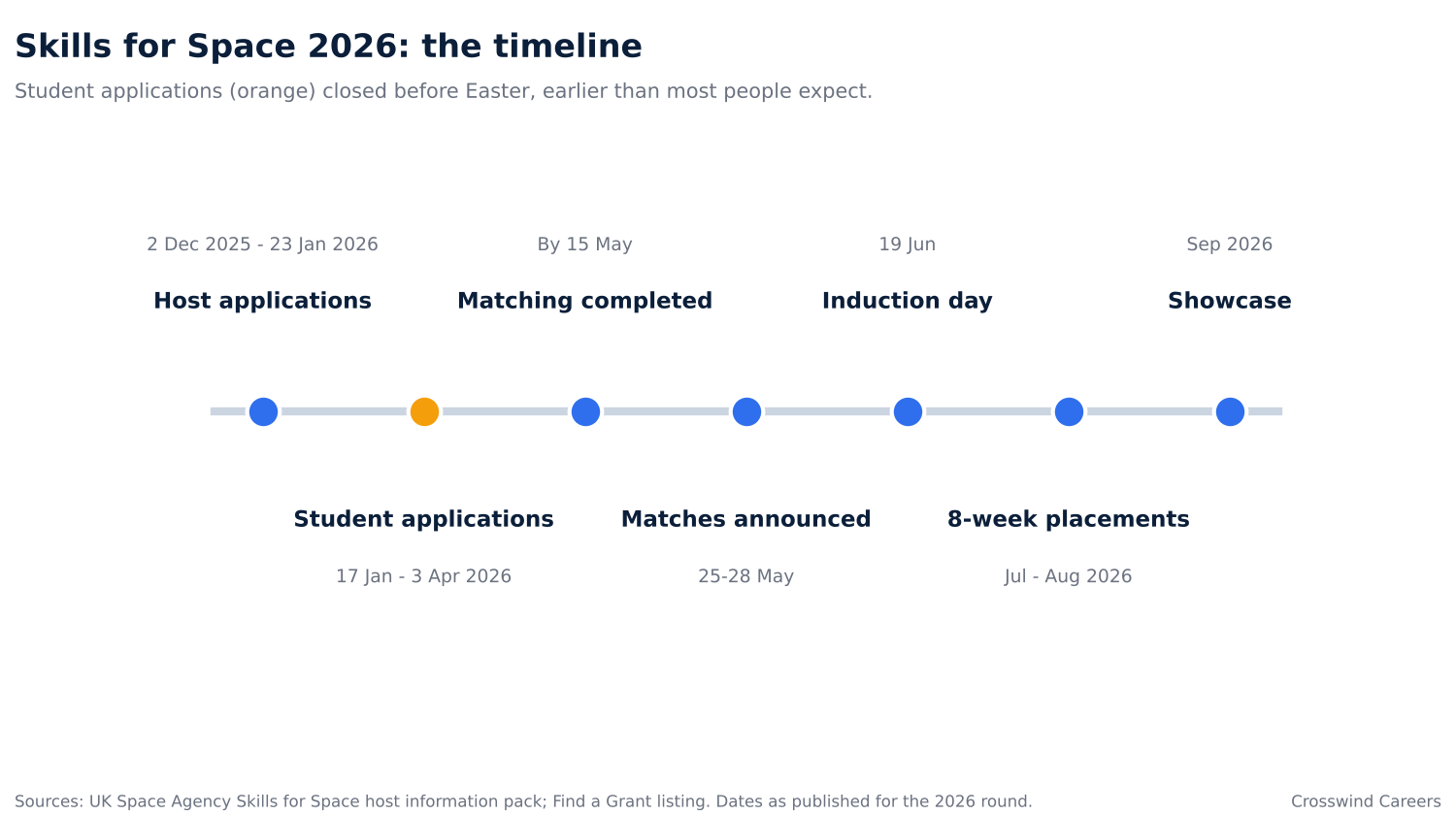
The 2026 timeline, from the host information pack and the government grants listing, gives a useful picture of how long the whole thing takes. Host applications ran from 2 December 2025 to 23 January 2026. Intern applications ran from 17 January to 3 April 2026. Matching finished around 15 May, matches were announced from 25 to 28 May, the induction day was planned for 19 June, placements ran across July and August, and the showcase was scheduled for September 2026. If you wanted a summer 2026 placement, you needed to be applying before the Easter holidays, which is earlier than most students start thinking about summer work.
As of mid-October 2026, the Satellite Applications Catapult's internships page marks both its own paid summer internships and the Skills for Space programme as closed, and we found no announced intake for summer 2027. That is not the same as the programme being cancelled. It means the next round, if there is one, has not been published yet. Based on the 2026 timeline, an equivalent round for summer 2027 would most likely open between December and January, with student applications in the early part of the year. That is a prediction based on one year's calendar, not a promise, so check the UK Space Agency's pages rather than relying on this article for dates.
The realistic advice is to treat the next few months as preparation time and to keep other routes open in parallel.
Because the process for both schemes leans on written answers and short interviews, you need two or three concrete things you can describe well. A CubeSat or rocketry society project, a final-year or second-year design module, a Python or MATLAB project that analysed real data, a 3D-printed or electronics build, or a space-related volunteering role all count. What matters is that you can explain what the problem was, what you personally did, and what you learned. If you are an engineering student who has spent a year doing coursework and nothing else, build one small thing now.
Skills for Space asked for a transcript and an academic character reference. Ask a lecturer or personal tutor now, rather than in the week of the deadline, whether they would be willing to write one, and keep a current copy of your transcript to hand.
The 2026 scheme was for second- and third-year undergraduates and second-year FE students who would still be in education the following September. If you are a final-year student who will have graduated before the placement starts, you may fall outside a scheme designed that way, so plan for graduate routes instead.
Both SPIN and Skills for Space placed students in engineering, software, data science and business functions, and in different parts of the country. Students who treat the application as a search for the one perfect satellite engineering project tend to narrow their own chances. Applying to a data or software placement at a space company can be the quickest route into a team that also builds hardware.
Some space and defence work involves vetting. Our guide on why aerospace jobs sometimes require security clearance explains how that works: Why the Best Aerospace Jobs Sometimes Require Security Clearance, and How That Process Actually Works.
A placement through a government scheme is the best known route, not the only one.
The Satellite Applications Catapult runs its own paid eight-week summer internships for students, working on live projects in areas such as in-orbit servicing, Earth observation and positioning, navigation and timing. Its internships page also lists other paid summer placements from sector organisations, including engineering internships at Orbit Fab and industrial and summer placements at the Science and Technology Facilities Council, plus work experience at STFC and Diamond.
UKspace, the trade association, keeps a list of pre- and early-career opportunities. It includes SpaceCareers.uk, a non-profit jobs and advice service, the Prospero Space Fellowship, which offers mentorship, paid internships and a leadership retreat to university students from across the UK, and the Space Park Leicester internships portal, which lists internships from participating organisations. For graduates it lists the European Space Agency's Young Graduate Trainee programme, a one-year programme in space mission development and operations, and early careers schemes at QinetiQ, Airbus and Thales, as well as apprenticeships.
If you want to see where space companies are hiring and how the work differs by employer, our guide to SpaceX and Blue Origin's UK and European expansion covers which parts of the sector are growing in the UK and which skills keep showing up: SpaceX and Blue Origin's UK and European Expansion: The Complete Guide.
In 2026 the student window opened mid-January and closed in early April, and the host matching was already finishing in May. Students who started looking in June found the programme closed.
Anonymous scoring and structured matching mean generic answers are scored against specific skills. A paragraph that could have been written for any company will lose to one that engages with the listing.
Many pages still describe SPIN with its old grant amounts and its old application route. Always check the date on anything you read, including this article, and go back to the UK Space Agency and the Satellite Applications Catapult for current details.
Places are limited and demand is high, so a rejection tells you very little about your ability. The 2024 booklet itself noted that demand exceeded supply.
A SPIN placement used to be one of the cleanest ways for a UK student to get paid space experience before graduating. For 2026 the model changed to Skills for Space, with 50 funded placements, a central matching process, a £5,000 intern payment and a rule that stops past SPIN interns re-applying. As of October 2026 the current rounds are closed and no 2027 round has been announced. What you can control is being ready: a transcript and a referee lined up, two or three projects you can describe clearly, and a plan B that does not depend on one scheme reopening.
Subscribe to Crosswind Careers for weekly aviation, aerospace and space career breakdowns - no commercial stake, no marketing.
GET IN. STAND OUT. TAKE OFF.

Aerospace engineering student at Kingston University London, on track for a First (89% in first year, 85% in second). In March 2026 our hybrid rocket engine, MAKAW 2, burned for 10 seconds at 130 N peak thrust, and I made its injector plate. I work in SolidWorks and ANSYS. Co-founded Crosswind to give people straight answers about getting into aviation and aerospace.

Honest aviation and aerospace career guidance for the next generation.